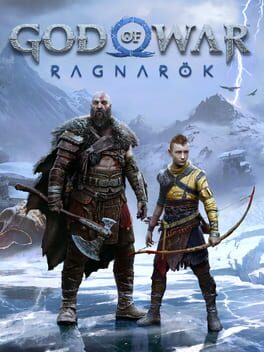
God of War Ragnarök — A Worthy Conclusion to a Myth Reborn
God of War Ragnarök is the culmination of a remarkable creative reinvention. When Santa Monica Studio relaunched the franchise in 2018, they transformed Kratos from a one-dimensional avatar of rage into a nuanced, deeply sympathetic father figure struggling to raise his son Atreus in a world of gods and monsters. Ragnarök builds on this foundation with confidence and ambition, delivering a sequel that is bigger, bolder, and more emotionally resonant than its predecessor in almost every way.
The combat system has been refined to a razor's edge. Kratos's Leviathan Axe and Blades of Chaos remain two of the most satisfying weapons in all of gaming, and Ragnarök introduces new weapon types, runic abilities, and companion mechanics that keep the combat fresh throughout the game's substantial runtime. The addition of playable Atreus sections provides welcome variety, showcasing the young god's unique fighting style and providing narrative heft. Boss encounters are spectacularly staged, with each major fight feeling like a true clash of titans.
The narrative is where Ragnarök truly shines. The evolving relationship between Kratos and Atreus — the tension between a father who wants to protect and a son who needs to find his own path — is handled with remarkable emotional maturity. Christopher Judge and Sunny Suljic deliver performances that are nothing short of extraordinary. The supporting cast, including standout performances by Ryan Hurst as Thor and Richard Schiff as Odin, adds layers of complexity to the Norse mythological backdrop.
The game's scope is enormous. Nine realms, each distinct in visual identity and gameplay opportunities, offer dozens of hours of exploration beyond the main story. Environmental puzzles are cleverly designed, collectibles are meaningful, and the optional content — including the Berserker battles and Muspelheim challenges — provides substantial endgame engagement. The world-building is meticulous, weaving Norse mythology into a cohesive narrative framework that manages to feel both epic and intimate.
The visual design across the nine realms is consistently breathtaking. Svartalfheim's dwarven mines glow with molten metal and industrial grandeur. Alfheim's vast deserts shimmer with an otherworldly light that shifts between blinding brightness and eerie twilight. Vanaheim's lush jungles teem with wildlife and hidden ruins. The environmental variety ensures that exploration never becomes visually monotonous, and each realm's distinct color palette and architectural style reinforces its cultural identity within the game's mythological framework.
Bear McCreary's musical score is a triumph that elevates every moment of the experience. The thunderous percussion of combat themes, the delicate strings of emotional scenes, and the haunting vocals of the realm-specific ambient music create a sonic landscape that is as meticulously crafted as the visual one. The vocal performances of the entire cast — from Judge's gravelly, emotionally layered Kratos to Suljic's passionate, impulsive Atreus — bring a level of authenticity to the motion-capture performances that is genuinely moving. The scene where Kratos finally tells Atreus 'I am proud of you, boy' is a payoff years in the making, and its emotional impact is earned through careful, patient character development.
The Favour side quests represent a significant improvement over the 2018 original. Each Favour feels substantial and purposeful, often revealing important lore or providing meaningful character development for the game's extensive supporting cast. The questlines involving Freya's transformation from antagonist to reluctant ally are particularly well-handled, providing a nuanced exploration of grief, betrayal, and forgiveness that enriches the main narrative considerably.
The accessibility options in Ragnarök are industry-leading. A comprehensive suite of settings allows players to customize nearly every aspect of the experience, from combat difficulty and puzzle timing to audio descriptions and high-contrast visuals. The game's commitment to inclusive design ensures that its story and gameplay can be experienced by the widest possible audience without compromising the core experience for any player.
The endgame content provides compelling reasons to continue exploring after the credits roll. The Berserker Gravestone encounters offer some of the most challenging combat in the game, requiring mastery of advanced techniques and build optimization. The Muspelheim trials return with expanded challenge variants, and the hidden realm-specific collectibles encourage thorough exploration of every corner of the nine realms. The New Game Plus mode, added post-launch, allows players to experience the story again with fully upgraded equipment and new armor sets, providing fresh tactical options for returning players.
The environmental puzzle design deserves particular recognition for its ingenuity and variety. Each realm introduces unique puzzle mechanics tied to its environmental identity — the time-manipulation crystals in Alfheim, the water-level controls in Svartalfheim, the wind-powered mechanisms in Vanaheim — ensuring that exploration never feels repetitive. The companion-specific puzzle interactions, where Atreus and later other allies contribute unique abilities to solve environmental challenges, reinforce the game's central themes of cooperation and trust.
God of War Ragnarök is a masterful achievement that cements Kratos's modern saga as one of gaming's greatest narrative triumphs. It delivers on every front — combat, story, spectacle, and emotional depth — and stands as a fitting conclusion to one of the medium's most remarkable creative reinventions.