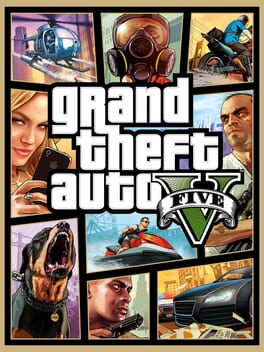
Grand Theft Auto V — A Sun-Drenched, Cynical Masterpiece of the American Nightmare
Since its controversial inception in the late 1990s, the Grand Theft Auto franchise has served as the video game industry’s loudest, most profane, and most wildly successful agent of chaos. It has always been a lightning rod for cultural debate, heavily criticized by mainstream media as a brain-rotting murder simulator while being celebrated by millions of players as the ultimate digital sandbox of unbridled freedom. But to dismiss Rockstar Games' magnum opus, the 2013 titan Grand Theft Auto V, as merely a game about stealing cars and causing explosions is to fundamentally misunderstand its absolute narrative brilliance and its razor-sharp sociological fangs. GTA V is not just a sandbox; it is the most expensive, expansive, and ruthlessly biting satirical mirror ever held up to 21st-century Western culture. Moving away from the gritty, oppressive, immigrant tragedy of its predecessor (GTA IV), the fifth installment bathes itself in the neon-lit, sun-soaked, smog-choked superficiality of Los Santos—a hyper-detailed, stunningly accurate parody of Los Angeles. Beneath the glossy veneer of Hollywood parodies, fake social media networks, and meticulously curated radio stations lies a deeply philosophical, aggressively nihilistic examination of the "American Dream," a concept the game argues is not just dead, but rotting from the inside out, completely driven by greed, hypocrisy, and a sociopathic obsession with celebrity.
The most revolutionary narrative leap GTA V takes is its complete abandonment of the traditional, singular hero in favor of a tri-protagonist structure. This was not merely a gameplay gimmick to keep the action moving; it was a brilliant thematic device used to dissect the varied psychologies of the players who engage with the franchise. Our first protagonist is Michael De Santa, a retired, wealthy, middle-aged bank robber living in a sprawling mansion in the affluent Vinewood Hills. Michael represents the hollow realization of the American Dream. He has the money, the house, the sports cars, and the pool, but he is utterly miserable. His wife despises him, his children are grotesque caricatures of spoiled, lazy, fame-obsessed youth, and he spends his days drinking whiskey, watching old action movies, and paying a fraudulent therapist to validate his narcissism. Michael represents the aging gamer, the nostalgic hypocrite who claims to want a peaceful life but is secretly addicted to the adrenaline of chaos, betrayal, and violence.
Contrasting him is Franklin Clinton, a young, ambitious gang banger from the impoverished neighborhoods of South Los Santos. Franklin is the traditional, classic GTA protagonist archetype—the rags-to-riches hustler looking to claw his way out of the hood and make something of himself. He possesses a moral compass, albeit a heavily compromised one, and looks up to Michael as a twisted sort of mentor. Franklin's tragedy is that he genuinely believes escaping poverty will solve his problems, only to realize that the wealthy elite of Vinewood are just as ruthless, if not more sociopathic, than the street gangs he left behind. The only difference is that the rich hide their violence behind expensive tailored suits and corporate lawyers.
And then, there is Trevor Philips. If Michael represents the player’s desire for cinematic narrative, and Franklin represents the traditional progression mechanics, Trevor is the pure, unfiltered embodiment of the player's Id. Living in a filthy trailer in the dusty, meth-addled wasteland of Blaine County, Trevor is a psychotic, mass-murdering, completely unpredictable force of nature. He is the physical manifestation of the exact chaotic behavior players have always exhibited when free-roaming in a GTA game. When you switch to Trevor, you might find him waking up on a beach wearing a dress surrounded by dead bodies, or actively fighting the police, or screaming at a pigeon. Yet, in a stroke of absolute writing genius, Trevor is arguably the most honest character in the entire game. In a city built entirely on fake smiles, corporate jargon, and superficial backstabbing, Trevor makes no excuses for the monster he is. He exposes the hypocrisy of Michael and the corruption of the government agents they are forced to work with. He is a terrifying, hilarious, and utterly mesmerizing achievement in character design.
The interlocking narrative of these three men centers around a series of massive, cinematic "Heists." These multi-staged missions represent the absolute zenith of open-world mission design. The game meticulously walks you through the agonizing, thrilling process of casing a jewelry store, stealing the getaway vehicles, acquiring the knockout gas, choosing your crew (where hiring cheaper accomplices might result in them dropping the loot or crashing their bikes), and finally executing the score in a thunderous climax of adrenaline and gunfire. The seamless transition between the three characters during these shootouts—switching from Michael laying down suppressing fire, to Franklin driving the getaway car, to Trevor sniping from a helicopter overhead—flows with the breathtaking kinetic energy of a Michael Mann film like Heat.
Yet, for all the immense wealth they acquire through these daring robberies, the philosophical core of GTA V remains aggressively pessimistic. The millions of dollars do not cure Michael's deep-seated depression, they do not bring Franklin the genuine respect he craves, and they certainly do not fix Trevor's broken, psychotic mind. The world of Los Santos surrounding them is a carnival of grotesque consumerism. You can walk the streets and listen to pedestrians loudly discussing their vapid diets and fake spiritual awakenings. You can watch in-game television shows that brutally parody reality TV and the military-industrial complex. You can browse an in-game internet that mocks tech giants, social media vanity, and the absurdity of modern politics. Every billboard, every radio commercial, every line of pedestrian dialogue is dripping with a venomous, hysterical cynicism toward a society that worships money above all human decency. Even the government agencies in the game—the FIB and the IAA—are depicted as infinitely more corrupt, bloodthirsty, and self-serving than the bank robbers they are supposed to be hunting.
Ultimately, Grand Theft Auto V is a monumental, sprawling titan of digital world-building. It is an engineering marvel that manages to make a massive, seamless map feel intricately handcrafted and bursting with life. But beneath its chaotic shootouts, its breathtaking sunsets over the Pacific Ocean, and its endless sandbox of vehicular destruction, lies a brilliant, unapologetic literary satire. It dares to hold up a mirror to the ugliest, most absurd, and most greed-driven aspects of modern civilization, and forces us to laugh out loud at our own tragic reflection.