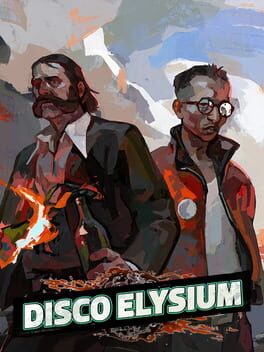
Disco Elysium — The Greatest Writing in Video Game History
Disco Elysium asks a radical question: what if the most interesting battles in an RPG happened entirely inside your own head? ZA/UM's debut game strips away combat, loot, and experience points in the traditional sense. What remains is pure, undiluted narrative — a murder mystery set in a decaying coastal city, investigated by an amnesiac detective whose own fractured psyche is both his greatest tool and his most dangerous adversary. It is, without question, the most brilliantly written video game ever made.
The game's 24 skills are not typical RPG stats. They are voices in your head — literal aspects of your personality that interject during dialogue with often hilarious, sometimes devastating commentary. Electrochemistry urges you toward drugs and pleasure. Inland Empire whispers surreal, almost mystical observations about the world. Authority demands that others respect your badge. Each skill has its own personality, its own agenda, and its own failures. Speccing heavily into a single stat doesn't just change your capabilities — it fundamentally alters the texture of your inner monologue.
The writing is extraordinary in both quantity and quality. The game contains over one million words, and the prose quality is consistently stunning. The political system — which allows you to align with communism, fascism, ultraliberalism, or moralism — doesn't judge your choices but rather explores them with intellectual rigor and dark humor. The world of Revachol, with its post-revolutionary malaise and ethnic tensions, feels uncomfortably relevant to contemporary geopolitics, yet it never becomes preachy or didactic.
The art direction, rendered in an expressive oil-painting style, is hauntingly beautiful. The dilapidated Whirling-in-Rags hostel, the frozen bay, the industrial boardwalk — every location drips with atmosphere and narrative significance. The soundtrack by British Sea Power is a moody, ethereal accompaniment that perfectly underscores the game's melancholic tone.
The Thought Cabinet system is a stroke of genius that gamifies ideology. As you encounter ideas through dialogue and exploration, you can 'internalize' them — spending time mulling over concepts like 'Mazovian Socio-Economics' or 'Hobocop' until they become part of your character's worldview, granting mechanical bonuses. This system transforms philosophical alignment from a binary choice into a process of intellectual experimentation, where adopting contradictory ideas simultaneously is not just possible but mechanistically rewarding. It is perhaps the most innovative character progression system in RPG history.
The Final Cut edition, which added full voice acting to the entire script, transforms the experience. Every line of the game's million-word script is now performed by a talented cast, with the narrator in particular delivering a performance of extraordinary range — shifting from sardonic wit to genuine pathos within a single paragraph. The addition of new political vision quests further deepens the game's ideological explorations, providing extended questlines for each of the four political alignments.
The character of Kim Kitsuragi, your partner detective, is one of the finest NPCs in gaming history. His quiet competence, dry humor, and genuine decency provide a moral anchor in a game that otherwise delights in ethical ambiguity. Your relationship with Kim — which can range from deep professional respect to embarrassing incompetence depending on your choices — provides the game's emotional through-line and its most resonant moments of genuine human connection.
Disco Elysium proves that video games can be literature. Not 'literature-adjacent,' not 'almost as good as a book,' but genuine, boundary-pushing literature in its own right. It is funny, tragic, politically provocative, and deeply humane. It is a game that trusts its audience to engage with complexity, ambiguity, and discomfort. For anyone who believes that writing matters in games, this is the ultimate validation.
The Martinaise district, the game's sole explorable location, is a masterwork of environmental storytelling that squeezes extraordinary narrative density into a relatively small physical space. Every building, every garbage-strewn alley, every frozen coastline is layered with history, meaning, and discoverable content. The abandoned church, the dockworkers' union offices, the mercenary tribunal site, and the mysterious island accessible only at low tide each contain self-contained narrative ecosystems that reward thorough exploration. The district functions as a microcosm of the larger world's political and social tensions, creating a sense of scope that belies the game's modest geographic footprint.
The character of Kim Kitsuragi deserves particular praise as one of the most well-realized partner characters in RPG history. His quiet competence, his unwavering professionalism, and his subtle emotional reactions to the player's increasingly unhinged behavior create a grounding presence that anchors the game's more surreal and chaotic moments. The relationship between the detective and Kim — which can develop from wary professional courtesy into genuine mutual respect, understanding, and lasting friendship — provides the game's emotional backbone and its most resonant, deeply human moments of authentic connection.
The absolute sheer density and unprecedented quality of Disco Elysium’s writing cannot be overstated; it feels less like a traditional video game and considerably more like interacting with a masterpiece of existentialist literature. The developers at ZA/UM completely rejected the traditional, violent mechanics of modern role-playing games, choosing instead to focus entirely on intense, dialogue-driven conflict, complex internal psychology, and deep political philosophy. The game forcefully makes you confront profoundly uncomfortable, incredibly nuanced thematic questions surrounding political ideology, soul-crushing regret, rampant substance abuse, and the incredibly difficult, painful process of attempting to rebuild a shattered, broken identity in a decaying world. Through the incredibly innovative use of your detective's own wildly fractured, arguing psychological traits as your main party members, it creates a deeply personal, wildly unpredictable narrative experience. It is a towering, unmatched triumph of profound narrative design and a true watershed, historical moment for the entire RPG genre.