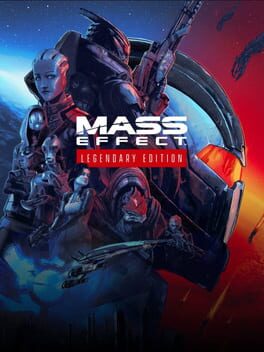
Mass Effect Legendary Edition — The Definitive Space Opera
The Mass Effect trilogy is the greatest space opera in gaming history, and the Legendary Edition is the definitive way to experience it. BioWare's remastered collection brings all three games — Mass Effect, Mass Effect 2, and Mass Effect 3 — together with improved visuals, unified gameplay mechanics, and all previously released DLC. The result is a seamless, 100-plus hour journey across the galaxy that showcases some of the finest character writing, world-building, and player-driven storytelling the medium has ever produced.
Commander Shepard's saga — from the discovery of the Prothean beacon on Eden Prime to the final confrontation with the Reapers — is one of gaming's most emotionally investment character journeys. The fact that your choices carry across all three games, shaping relationships, political outcomes, and the fate of entire civilizations, creates a sense of narrative ownership that remains unmatched. The import system means that a decision made in the first game's opening hours can have devastating consequences sixty hours later in the trilogy.
The companion characters are BioWare at their absolute best. Garrus Vakarian's evolution from rigid C-Sec officer to Shepard's most loyal confidant is one of gaming's great friendships. Tali'Zorah's journey of cultural identity resonates deeply. Mordin Solus's moral reckoning with the genophage is heartbreaking. Liara T'Soni's transformation from shy archaeologist to ruthless information broker spans the entire trilogy. These are not just party members — they are friends, lovers, and family.
Mass Effect 2, widely considered the trilogy's peak, is a masterclass in mission design. Each loyalty mission is a self-contained short story that develops a companion's character while providing unique gameplay scenarios. The Suicide Mission finale, where every decision and relationship in the game converges into a branching, potentially devastating climax, remains one of the most ambitious set pieces in RPG history.
The Legendary Edition's improvements to the original Mass Effect are transformative. The modernized combat, improved Mako handling, and visual overhaul make the first game fully playable by modern standards, ensuring that the trilogy's slow-burn opening no longer serves as a barrier to entry. The complete DLC integration means that essential content like Lair of the Shadow Broker and Citadel is woven seamlessly into the experience.
The Citadel DLC, widely regarded as the franchise's finest piece of additional content, provides a love letter to the entire trilogy's character roster. The lighthearted tone, the character-specific combat scenarios, and the final party sequence — where every surviving companion gathers for an evening of celebration and farewell — create one of gaming's most emotionally satisfying conclusions. For many players, this DLC represents the true ending of Commander Shepard's story, providing the emotional closure that the base game's controversial finale left wanting.
The world-building across the trilogy creates one of science fiction's most detailed and internally consistent universes. The Codex system, which provides encyclopedic entries on every species, technology, and historical event in the Mass Effect universe, demonstrates a depth of lore-building that rivals literary science fiction. The Mass Relay network, the political dynamics of the Citadel Council, the biology and culture of each alien species — these elements create a universe that feels lived-in and plausible in ways that most sci-fi media cannot achieve.
The moral choice system, while binary in its Paragon-Renegade structure, generates surprisingly nuanced narrative outcomes when choices compound across three games. The genophage decision, the geth-quarian conflict, and the fate of the Rachni Queen create multi-game ethical dilemmas where there are no cleanly 'right' answers. The game's willingness to present morally complex situations without clear resolution elevates it above simple good-versus-evil narratives.
The combat evolution across the trilogy demonstrates BioWare's responsiveness to player feedback. Mass Effect 1's RPG-heavy, mechanically stiff combat gives way to Mass Effect 2's tighter, cover-based shooting, which further refines into Mass Effect 3's fluid, class-specific action. The Legendary Edition's unified control scheme smooths these transitions, creating a more cohesive gameplay experience across the hundred-plus hour journey.
The romance system across the trilogy creates character relationships of genuine emotional depth. The option to pursue romantic relationships with companions — from Liara's tender scholarly wisdom to Garrus's awkward but endearing vulnerability — adds personal stakes to the galactic conflict. The fact that romance choices persist and evolve across three games, with partners referencing shared history and reacting to periods of separation, creates relationship arcs that feel organic and earned in ways that single-game romances cannot achieve.
The multiplayer component of Mass Effect 3, included in the Legendary Edition, provides a surprisingly compelling cooperative experience. Four-player teams tackle wave-based survival missions across various maps, earning credits to unlock new character classes, weapons, and equipment through a randomized reward system. The class variety — including unique alien species with distinct abilities — and the challenging Gold and Platinum difficulty tiers provide substantial endgame content that complements the single-player campaign.
The Mass Effect Legendary Edition is an essential experience for anyone who loves science fiction, character-driven narrative, or RPGs. Commander Shepard's story is one of the medium's crowning achievements, and this collection ensures it will endure for generations.