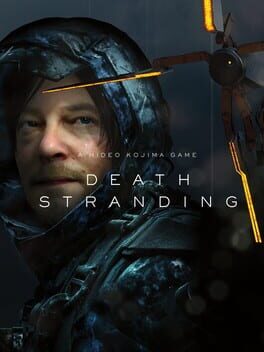
Death Stranding — The Beauty of Human Connection
Death Stranding is not a game that can be explained in a single sentence. It is a delivery simulation, a survival horror experience, a social commentary on isolation and connection, a science fiction epic about death and rebirth, and a meditation on the act of walking itself. Hideo Kojima, freed from the constraints of the Metal Gear franchise, created something utterly unique — a game that challenges nearly every assumption about what mainstream AAA entertainment should be.
The core gameplay loop — carrying packages across a devastated American landscape — sounds mundane on paper. In practice, it is surprisingly compelling. Every delivery is a logistical puzzle: you must consider weight distribution, terrain difficulty, weather conditions, and the ever-present threat of spectral BTs (Beached Things) and human MULE raiders. The traversal mechanics are genuinely innovative, with balance physics requiring careful attention and the terrain itself serving as the primary antagonist.
The social strand system is perhaps the game's most revolutionary contribution to game design. Structures built by other players — bridges, roads, ziplines, shelters — appear in your world as ghostly contributions from parallel universes. You cannot communicate with these other players directly; you can only experience the physical evidence of their efforts. Riding a road that hundreds of anonymous strangers contributed materials to build creates a profoundly moving sense of shared purpose. It is cooperation without communication, connection without contact.
Norman Reedus delivers a surprisingly nuanced performance as Sam Porter Bridges, a delivery man reconnecting a fractured America. The supporting cast — including Mads Mikkelsen, Léa Seydoux, and Troy Baker — brings gravitas to a story that, while often convoluted, contains moments of genuine emotional power. The relationship between Sam and the BB (Bridge Baby) strapped to his chest evolves into something unexpectedly tender.
The Director's Cut additions — including the rugged Ruined Factory area, new delivery missions, and the comprehensive Firing Range — substantially enhance the experience. The ability to race against ghost data from other players in the new race tracks adds a competitive element that complements the game's cooperative foundation. The upgraded visuals on PS5, with haptic feedback that transmits every footstep and load shift through the DualSense controller, create an even more physically tangible traversal experience.
Ludvig Forsell and the Low Roar band provide a soundtrack that perfectly captures the game's dual nature of isolation and connection. The licensed tracks — curated with Kojima's characteristic cinematic precision — are deployed at carefully chosen moments during long traversals, transforming routine deliveries into emotionally resonant journeys. The moment when music swells as you crest a hill and see the delivery center glowing in the distance below, all while the cargo on your back threatens to topple, is a uniquely Kojima experience.
The BT encounters, which require you to hold your breath and creep through ghost-infested territory while your BB's sensor arm waves frantically, are genuinely terrifying. The tactile feedback of the DualSense controller makes these sequences even more intense, with the haptic vibrations simulating Sam's heartbeat and the tension of his held breath. Boss encounters against massive BT creatures, while less frequent, provide spectacular set pieces that break up the meditative delivery gameplay with explosive action.
The road-building system represents the game's cooperative philosophy at its most compelling. Each road segment requires substantial material investment, and completing a road across a dangerous territory provides tangible benefits to every player in your network. The satisfaction of watching a road gradually extend across the map — each segment contributed by a different anonymous player — creates a collaborative achievement that no competitive multiplayer experience can match. The postal system, which allows players to leave gifts and encouraging messages for strangers, reinforces this theme of anonymous generosity.
The narrative's exploration of extinction events, societal collapse, and the nature of death itself is handled with surprising philosophical rigor. The concept of the Beach — a personal purgatory that each character experiences differently — provides a framework for examining mortality, grief, and the connections that persist beyond death. The game's final revelations about Amelie, Cliff Unger, and the true nature of the Death Stranding event weave together into a conclusion that, while characteristically Kojima in its complexity, achieves genuine emotional catharsis.
Death Stranding is not for everyone. Its glacial pacing, its arcane systems, and its Kojima-brand storytelling excess will alienate many players. But for those who surrender to its rhythm, it offers an experience unlike anything else in gaming — a game about the simple, revolutionary act of helping others, one delivery at a time. In a medium obsessed with destruction, Death Stranding dares to be about construction, and that alone makes it remarkable.
In a modern video game industry heavily dominated by safe, focus-tested sequels, derivative trends, and risk-averse corporate design, Hideo Kojima’s Death Stranding stands as a massive, unapologetic, and fiercely original artistic risk. Many deeply polarizing reviews initially mocked it as a mere "glorified walking simulator" or an "Amazon delivery driver game," but doing so willfully misses the profound narrative ambition underneath. It is a sprawling, wildly ambitious meditation on human connection, global isolation, and the incredibly fragile, intricate infrastructure that completely holds human society together. By making the literal act of physical traversal—balancing your heavy load, carefully gripping your backpack straps, deliberately studying the treacherous, rocky terrain—the core, engaging gameplay loop, Kojima forces the player to genuinely appreciate the immense, quiet struggle of the journey. When you finally crest a massive, snow-capped mountain, low on stamina and boots degrading, and the camera pulls back as a beautifully melancholic Low Roar song begins to play, Death Stranding transcends gaming; it becomes a profoundly moving emotional experience that cannot be found anywhere else.